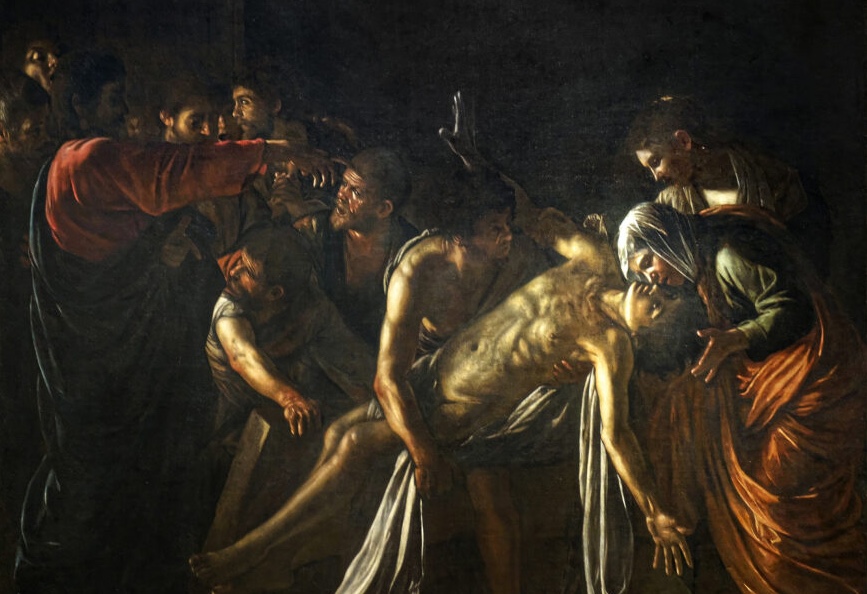
’“That’s all there is about the raising of Lazarus,” she whispered sternly and abruptly, and stood unmoving, turned away to one side, not daring to raise her eyes to him, as though she were embarrassed. Her feverish shaking still continued. The stub of the candle had long been guttering in its crooked candlestick within that wretched room, shedding its dim light on the murderer and the prostitute who had so strangely encountered each other in the reading of the eternal book.'
An axiom of Western liberal democracies has been that progress is linear. We are brought up to believe in the inexorable march of economic growth that pulls up each successive generation of young, ambitious people with it, and the experience of those living in the US or EU has largely borne that out since 1945. However, speak to my generation today, whether Millennials or Gen X-ers, and you are not likely to hear these articles of faith repeated. Instead of hope, ambition and purpose, you are far more likely to hear scepticism, apathy and anxiety about the future.
These emotions are grounded in hard economic reality. A recent report in the UK detailed how the number of young people not in employment, education, or training (NEETs), has now risen to 1 million (GOV.UK). This report, investigating youth employment, details how 1 in 8 young people are now NEETs, with an 89,000 year-over-year increase from the 2025 data. Journalists quickly ascribed the causes: post-Covid trailing health problems, economic stasis, lack of entry-level roles, rising taxes on businesses, social media algorithms, etc. All of these undoubtedly contribute, and together, they are projected to bring the total number of NEETs up to 1.25 million or 1/6 young people within 5 years. This is a problem with impacts far beyond the lives of the NEETs themselves. This means 1 million people not in work, not paying taxes, isolated, suffering from mental or physical health conditions, all of which reverberate across society as a whole. They might seem like an extreme example, but the NEETs are the acute end of a wider generational malaise amongst young people, expressed through disaffection, apathy and anxiety. Whilst the scale of the problem might be exceptional, the themes themselves are not. One author who was deeply concerned by youth alienation and nihilism was Fyodor Dostoyevsky, and his diagnosis and prognosis of the problem remains as relevant today as it was 160 years ago.
Dostoyevsky’s works have always had a particular resonance with young people. His protagonists are in their twenties and suffer from an existential angst that every person, to varying degrees, can recognise, whether it’s Alyosha Karamazov in The Brothers Karamazov or the Underground Man in Notes from Underground. His most enduring character though, is the student Rodion Raskolnikov from Crime and Punishment. Dostoyevsky wrote Crime and Punishment in 1866, after returning from forced labour in Siberia due to a flirt with socialism – his analysis and critique of ideological radicalism is a core theme of the novel. It has the appearance of a tome, but his visceral depiction of urban deprivation in St Petersburg, searing psychological analysis of guilt, and deeply human portrayal of alienation and apathy, give the novel an internal dynamism that means you rarely feel its 600-page length. Analysts and critics have put it to use in every imaginable context across the political spectrum. Here though, I want to argue that it offers a deeply insightful lens into the generational malaise that defines young people today, exemplified by the ‘lost generation’ of NEETs (FT).
We experience Dostoyevsky’s world through Raskolnikov’s eyes. He inhabits a swelteringly hot St Petersburg, a labyrinth of overcrowded apartments and dank alleys, populated by the Russian urban poor. These masses, including Raskolnikov himself, have migrated in from the rural peripheries in search of riches in the metropole, as Russian society underwent a spasmodic transition from agrarian to industrial. In reality though, they simply traded rural serfdom for urban wage labour. Raskolnikov feels these conditions of deprivation intensely; he moves from filthy streets to festering canals, and rents a coffin-like room where the air curdles and almost asphyxiates him; it ‘sooner resembled a closet than a place of habitation,’ and yet despite the abysmal quality of the room, he is still heavily in arrears with his landlady. As a reader we experience these oppressive conditions as a character in and of themselves, the walls of his room become the narrow boundaries of a nightmarish existence defined by precarity, poverty, and dirt.
Dostoyevsky is not painting a picture of social deprivation to make an outwardly political argument in the form of an ideological call to arms. Instead, he uses it to show how wretched external conditions generate warped internal transformations in those who are subjected to them. Raskolnikov’s world, of deleterious accommodation, debt, and dilapidated cities are conditions recognised by many young people today, regardless of social position, but felt especially acutely by the NEETs. Dostoyevsky’s central point will be that these are never just external factors in people’s lives; these conditions can, and do, penetrate right into the psyche of those who suffer them. And we will see the disastrous consequences of this play out in Raskolnikov’s story.
Raskolnikov is a student, he’s educated, and in his mind, deserving of more. As such, he’s disgusted by the urban poor that he finds himself living with, but also ashamed of himself for not fulfilling the promise of his university education. Dostoyevsky writes of Raskolnikov, that after meeting the moneylender, ‘the sense of infinite loathing that had begun to crush and sicken his heart even while he had only been on his way to the old woman had now attained such dimensions and become so vividly conscious that he was quite simply overwhelmed by his depression.’ This pride is Raskolnikov’s original sin. He sees himself as better, more deserving than those around him, and because of this arrogance, to him the social contract is null and void. He has not been given the place in society that is his right, so in turn he owes absolutely nothing back to society. The norms and rules that others live by, and that are expected of him, become like the walls of his room – claustrophobic and asphyxiating – so he decides to smash free, challenging the very fabric of society in a shockingly apathetic act of violence.
Dostoyevsky is not making the deterministic argument that poverty necessarily breeds violence; Raskolnikov’s sin is internal pride, not his position in society. However his point is that conditions of social wretchedness, isolation from community, lack of work, and existential alienation are not just prosaic facts of life. They are deeply affecting on the mind, and latent with the potential for disaster. For Dostoyevsky, this disaster takes the form of political radicalism, and its inevitable righteous violence. Raskolnikov, attempting to justify his violence, couches it in the language of utopian political ideology. In an early discussion with Porfiry Petrovich, the investigator assigned to the murder, who brings up an old article Raskolnikov had written for a political journal, we see the outline of Raskolnikov’s nascent social philosophy. Raskolnikov explains that “human beings in general may be divided into two categories: a lower one (that of the ordinary)…and another group who possess a gift or talent for something new.” He continues that such an “‘extraordinary’ person has a right…to allow his conscience to step across certain obstacles…only if the execution of his idea (which may occasionally be the salvation of all mankind) requires it.” Here, Dostoyevsky skewers utopian ideologies that condone the violence of ‘stepping across’ social norms in the present, as a means to a greater good in the future. Raskolnikov claims his right as one of these ‘extraordinary’ actors, to do as he pleases, including, if he may “find it necessary, for the sake of his idea…to step over a dead body.”
Whilst Dostoyevsky is scathing of the ideals themselves, this is not a normative claim on those who are sucked in by them. Dostoyevsky is not condemning young radicals, and Crime and Punishment has often been misinterpreted in this way. Instead, Dostoyevsky is empathising with a jaded young generation whose alienation lead them to radicalism. He himself was lured by socialist absolutism, and paid a heavy price for this, suffering four years hard labour in a Siberian work camp. As such, in line with Russian critic Strakhov, it makes far more sense to view Crime and Punishment “not as a mockery of the younger generation, neither a reproach nor an accusation – [but] a lament over it.”
The genius of the novel comes as Dostoyevsky lifts the veil of radical political ideology, showing it to be an empty facade. Raskolnikov does not genuinely believe in some overarching philosophy that can justify his killing. When he makes his confession to Sonya later on in the novel, he reveals the fundamentally apathetic nature of the crime, and that he ultimately believes in nothing. When Sonya presses him on his motivations, asking “why…why did you say you did it in order to rob her, if you didn’t take anything?”, we get to the icy nihilism at the centre of the crime: “I don’t know,” Raskolnikov answers. This is Dostoyevsky’s argument that we can trace right up to today. Alienation and precarity are not just conditions experienced by some. They should be a concern for everyone in society, as they carry within them the seeds of a particularly dangerous kind of radicalism; a vacuous radicalism that is not motivated by any genuine outcomes, only disruption and destruction of the status quo.
Despite the bleak themes of guilt, poverty, and alienation, Crime and Punishment is, ultimately not fatalistic. Dostoyevsky offers a balm to the frigid nihilism of Raskolnikov. This is Sonya, the novel’s Manichean pole of hope and faith, in opposition to the cynicism and selfishness of Svidrigailov, each competing to pull Raskolnikov with them. The themes that Sonya represents, and the ultimate catharsis that she is able to engender, are the prognosis that Dostoyevsky can offer to the alienation and apathy that afflicts young people today, and in particular those that suffer the acute end of precarity and isolation such as the NEETs. Raskolnikov imagined that he would be able to easily brush off his crime by justifying it as his right, by virtue of his status as an “exceptional” individual, on the superior side of his bifurcation of society. He cannot though. His guilt follows him, both physically wracking him in sickness and hallucinations, but also in the form of the taunting investigator Porfiry, who we can’t help but feel is always one step ahead of Raskolnikov. These external manifestations of his guilt are important, however it is through Sonya that we understand Dostoyevsky’s emphasis on the more fundamental interior nature of this crime and the path to true rehabilitation.
She reads him the story of Lazarus, which penetrates right through Raskolnikov’s self-delusions, shocking him. After hearing the biblical story, ‘he knew now…that even though she was miserably unhappy and horribly afraid of something…in spite of all her misery and fear…it was him she wanted to read to, to make sure he heard it.’ Eventually his guilt overcomes him, and he confesses to her. Sonya sees immediately that not only is this crime an attack on society, but Raskolnikov has also violated inner, moral laws. As such, she knows that purely external repentance, through prison or exile, cannot suffice to relieve Raskolnikov from his guilt. The only catharsis can come through internal rehabilitation; he must admit what he has done and the nature of his crime to himself as well as society. Dostoyevsky writes:
‘He suddenly recalled Sonya’s words: “Go up to the crossroads, bow to the people, kiss the earth, because you have sinned against it too, and tell the whole world out loud: ‘I’m a murderer!’” In remembering them, he had begun to tremble all over. And such a crushing weight did he now carry from the hopeless despair and anxiety of all this recent time, and especially of the last few hours, that he fairly leapt at the chance of this pure, new, complete sensation. It suddenly hit him like an epileptic seizure: a single spark began to glow within his soul, and suddenly it engulfed everything, like fire. Everything in him instantly grew soft, and the tears came spurting out. He fell to the ground where he stood’
For Sonya, and Dostoyevsky, this centres religion as the path to salvation. Raskolnikov can only relieve his guilt through joining Sonya in her devout Orthodox Christian faith. We don’t necessarily need to impose this literally on contemporary conditions though. What Raskolnikov is ultimately suffering from is isolation and alienation; and what Sonya’s, and Raskolnikov’s, eventual faith represents is connection – or rather, reconnection. The trap of the NEET generation and many other young people today, is that the material conditions of economic precarity and algorithmic anxiety, generate a profound loneliness and disconnection that has no communal outlet or wider social vent. Sonya’s ‘crosses’, can be read today as any form of human connection that performs the function of religion, bringing, lonely and marginalised young people back into the folds of society. This is the core of Crime and Punishment, and, after slogging through 600 pages of existential guilt and anguish, the ultimate hope that it offers. The solution to conditions of alienation, anxiety and apathy is not large-scale social revolution or upheaval; it’s the tiny human-to-human interactions that together make up the fabric of society.